

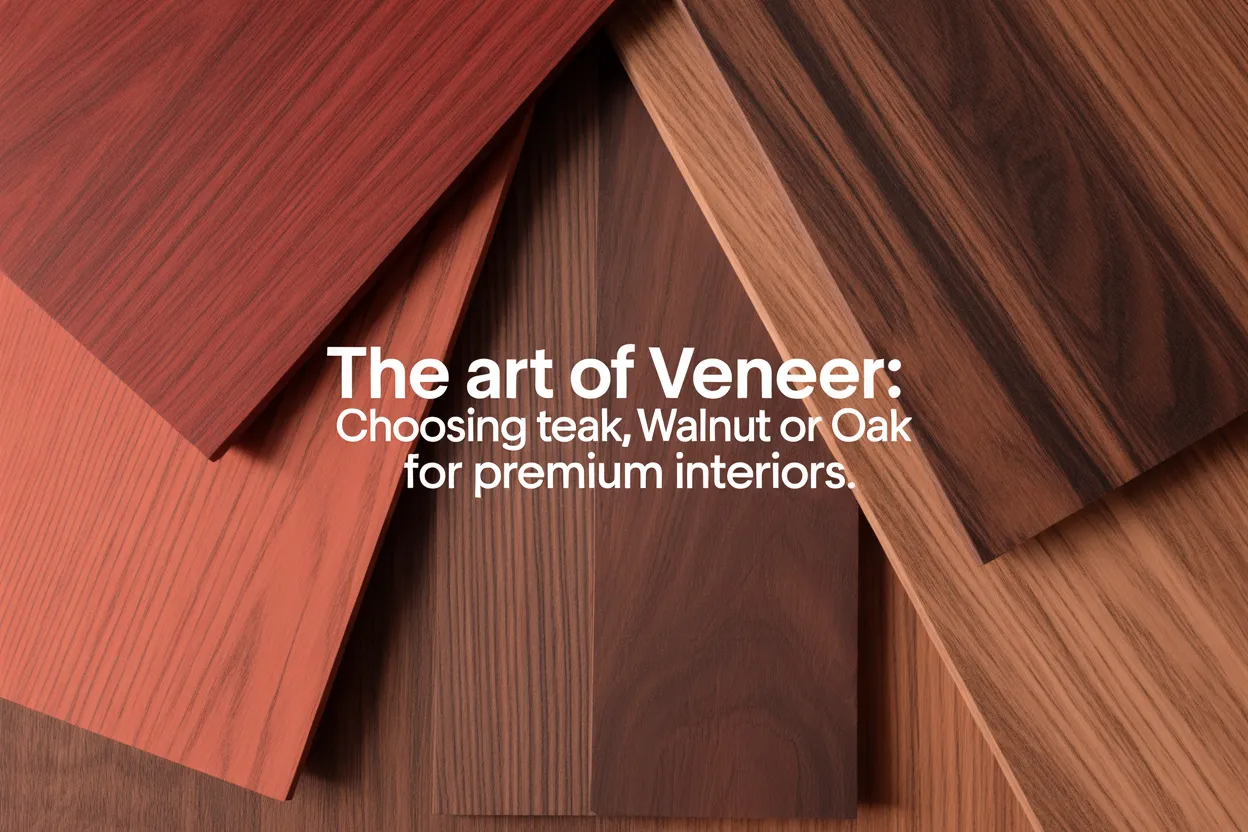
The Art of Veneer: Choosing Teak, Walnut or Oak for Premium Interiors

- Key Takeaways
- What is natural veneer?
- The journey from tree to surface
- A designer’s guide to premium woods
- The silent language of grain
- Beyond aesthetics: veneer performance
- Challenges in veneer application
- Conclusion
- Frequently Asked Questions
Key Takeaways
- Natural veneer offers real wood features, genuine wood beauty, distinct grain and color variations, all of which make each piece unique and ideal for a wide range of design settings.
- Opting for natural veneer is stunning and sustainable since it utilizes less wood than solid timber and promotes responsible forestry.
- The goodness and beauty of veneer are in the sourcing, the slicing technique, and the skill of the craftsman.
- Myriad wood species such as teak, walnut, and oak lend varied durability, grain, and color, providing designers with an array of desired aesthetics and functional benefits.
- To keep your natural veneer looking good as new, it’s important to properly install it, perform maintenance, and make repairs at the first sign of damage.
- Think eco-conscious and future worth when choosing veneer and partner with quality purveyors and seasoned pros for optimal outcomes.
Natural veneer is a super-thin slice of genuine wood that is applied over furniture, doors, or walls to get a wood look without the expense of using solid timber.
It retains the grain and texture of real wood, so each is one of a kind. Woodworkers, builders, and designers rely on natural veneer for panels, cabinets, and crafts.
The following chapters detail how natural veneer is made, where it works best, and what distinguishes it from other surfaces.
What is natural veneer?

Natural veneer is a thin cut of real wood sliced from a whole log, typically measuring 0.6 mm in thickness. Every veneer sheet captures the genuine look of the tree, its grain, its color and its slight imperfections. Veneer can be cut from many woods, including oak, maple, walnut, teak and more, allowing for different styles and applications.
It utilizes less wood than solid lumber, making natural veneer sustainable and less wasteful. It’s flexible and lightweight, making it a popular choice for furniture, wall panels and intricate decorative work.
1. The essence
Real wood veneer adds warmth and an organic aesthetic to spaces that man-made materials cannot. Every piece of veneer displays the individual tree grain and color from which it originated; consequently, no two sheets are identical. That uniqueness lends character to interiors, be it a tabletop, cabinet door, or feature wall.
Natural veneer preserves the inherent character of the wood. Expert craftsmen endeavor to safeguard the wood’s inherent pattern and colors, shunning any aggressive chemicals or treatments that might alter its appearance.
Natural veneer enables designers to utilize rare or expensive woods in an economical manner, allowing it to be available for numerous projects. Natural veneers are another sweet spot of green design. Each log produces multiple thin sheets, so more surfaces can be covered with less wood.
It’s a strategy that helps preserve forests and promotes sustainable sourcing.
2. The process
Veneer making begins with selecting premium logs, known as veneer-grade logs, which are essential for producing high-quality natural veneer production. These logs are precious gems, chosen for their straight grain, even color, and complete absence of knots or flaws. After selection, the logs are sliced into thin stone veneer sheets, known as lamellas, that enhance the aesthetics of various applications.
Veneers are cut in different ways: flat-slicing, quarter-slicing, rift-cutting, and rotary cutting. Each method brings out a unique grain pattern and texture. Rotary cutting results in wide sheets with bold patterning, while sliced veneers exhibit finer, straighter lines, adding to their versatility.
The sliced sheets are stacked in order, typically in packs of 24 or 32, ensuring the grain continues seamlessly from one sheet to the next. Talented hands must be employed at each phase, as it’s a delicate operation to slice the log, dry the sheets, and match them for a flawless appearance on finished surfaces.
3. The alternatives
Engineered and reconstituted veneers, often referred to as natural veneer production, are entirely artificial. These products are crafted from layers of wood or fibers that are glued and pressed together. While they can mimic various wood appearances, they often lack the dimensional quality of real wood veneer’s grain. Synthetic veneers, made from plastic or paper, offer durability but can feel flat and different compared to natural stone veneer options.
Natural veneer stands out for its unique grain and warmth, making it a preferred choice for many design needs. Although synthetic choices provide uniformity and affordability, they don’t wear like true timber. Dyed veneers, created by dyeing natural wood sheets, allow for adventurous colors and imaginative effects popular in contemporary designs. When selecting veneer, consider the impact on the environment, as natural veneer uses less timber and makes rare woods go further.
Choosing thin stone veneers can also enhance your project’s aesthetic appeal while being mindful of sustainability. Natural options like oakwood veneer not only offer beauty but also contribute to a more environmentally friendly approach, contrasting sharply with faux versions that may rely on harmful chemicals and depletable resources. This makes natural veneers a smarter choice for both style and ecological responsibility.
4. The feel
When you touch natural veneer, you sense the subtle ridges and heat of the genuine wood. The grain, knots, and small shifts in color pull the eye and the hand, beckoning folks to touch the surface. Various finishes can accentuate these features or provide a silky smooth feel.
We all resonate with natural stuff in our home and office. Wood surfaces can make a room feel peaceful, grounded, and inviting. Designers choose natural veneer not only for its beauty but for its warmth and the comfort it lends.
Selecting the proper material is about more than aesthetics. We believe the texture of wood, how wood responds to light, touch, and everyday activity, should inspire every design.
The journey from tree to surface

Natural veneer is a transparent, sequential journey from tree in the forest to furniture, construction, and design surfaces, including options like real wood veneer and thin stone veneers. This journey from tree to surface begins with selecting the perfect tree, progresses through slicing it into veneer sheets with loving craftsmanship, and culminates in the finished product prepared for practical application. Every step is essential to the appearance, durability, and excellence.
Sourcing
Responsible timber sourcing begins with understanding where the wood originates. Select timber from responsibly managed forests and you will protect natural resources and local communities. Illegal action and deforestation destroy ecosystems around the world and diminish the supply of fine logs.
Labels such as FSC establish criteria for sustainable logging. FSC-certified wood signifies that the forest is stewarded with concern for the environment and workers. Trusted producers honoring these standards ensure that the veneer is premium quality and responsibly sourced.
Doing business with partners like this protects against over-harvesting. It helps to promote supply chain transparency. Buyers and makers can verify the source and believe that the material is legal and ethical.
Slicing
Logs are softened by soaking in hot water or steam for hours or days, allowing the wood to become flexible. Once debarked, logs are either halved or quartered based on the desired pattern. Slicing employs alternative techniques, where flat slicing reveals wide, sweeping grain lines, while quarter slicing results in a straighter and more uniform appearance, frequently used for traditional designs. Veneer sheets are commonly sliced to a thickness of between 0.4 mm and 1.5 mm, contributing to the finished product’s quality.
Precision slicing is the secret to achieving the best results. Even a slight variation in thickness or angle can alter the entire appearance of the veneer. Newfangled machines keep the cuts even and minimize waste, allowing for better utilization of each log and less wood left over. This innovation in the natural veneer production process significantly enhances efficiency.
After slicing, drying follows. Air drying or special dryers remove moisture to ensure that sheets don’t warp or crack. Quality checks consider thickness, grain, and tactile feel, ensuring that only the best veneer sheets are selected. These sheets are then cut, joined, or pressed onto a backing prepared for finishing, ready for various applications in furniture making and architectural millwork.
The meticulous process of creating veneer sheets highlights the importance of precision and quality control. With advancements in technology, the production of thin stone veneers and real wood veneer has become more efficient, allowing for a huge selection of styles and finishes that cater to diverse design needs.
Finishing
Finishing reveals the wood’s true personality. Natural oils and waxes maintain the appearance authentic while providing some level of protection. Water-based finishes enjoy popularity due to their low VOC impact and their clear aesthetic.
Some finishes penetrate deep to protect against stains, while others sit on the surface and add luster. A quality finish goes a long way towards preventing damage from wear and tear, sun, or moisture. It facilitates cleaning.
The proper finish is dictated by the end use—floors require hard coats, whereas furniture might have a softer finish. Playing with finishes can alter a room’s ambiance. Others prefer matte for a sleek contemporary vibe. Some select gloss for traditional glimmer.
The end goal is always the same: a surface that stays beautiful and strong.
A designer’s guide to premium woods

Premium woods are the heart of high-end design, giving interiors both aesthetic and functional performance. Selected for their uncommon character, these woods provide designers with a means of sculpting environments that are elegant and inviting.
Natural veneer, which is comprised of paper-thin layers of actual wood, typically between 0.2 mm and 0.6 mm thick, provides a versatile, economical means of utilizing these materials. Veneer sheets bond to stable substrates like MDF or plywood, so you can have both flat and curved veneer. This technique allows maximum yield from every log, a wise, sustainable choice for today’s projects.
Selecting the right species is important because each contributes distinct hues, textures, and durability. A designer’s guide to fine woods. Knowing the qualities of wood guarantees a perfect match to every design, be it designing for strength, elegance, or both.
The teak profile
Teak distinguishes itself in its high oil content, rendering it resistant to moisture and decay. This inherent durability is why teak is a preferred wood for outdoor furniture and high-traffic areas. Its golden-brown color and straight, well-marked grain lend warmth and depth, maturing to a silvery-grey patina if untreated.
Teak plantations, when managed responsibly, contribute to durability and preserve wild forests. Most high-end vendors will now sell certified teak to guarantee responsible provenance. Designers use teak in both sleek modern and timeless surroundings.
Its stable veneer sheets wrap around curved walls or bespoke cabinetry, flaunting the wood’s distinctive grains. A matte, clear, water-based lacquer or UV-cured finish protects the surface and still enhances the wood’s character.
The walnut grain
Walnut’s grain is something to key in on. It can be straight or wavy, with curls that reflect light. These inherent differences impart each veneer sheet with a unique appearance, perfect for accent pieces of furniture or wall panels.
Color variations of walnut include:
- Deep chocolate brown
- Pale, almost blond streaks
- Warm greyish-brown
- Occasional purple or red undertones
Walnut is dense and strong, making it well-suited for fine furniture and accent pieces that have to endure. Its sophistication plays beautifully into both classic and contemporary spaces.
Designers frequently choose walnut for its combination of form and function, crafting it into desks, cabinetry, and feature walls.
The oak character
Oak is hard and long-lasting. It wears well in floors, beams, and doors. Oak veneer is supple enough for curves, yet resilient enough to resist dents and wear.
Not all oaks are alike. Each has its own grain. European oak frequently exhibits a straight, tight grain, whereas American white oak presents with more open, bold lines. Color can be anywhere from pale beige to deep honey, so choices suit numerous decor.
Designers count on oak’s versatility for both rustic and sleek styles. Its veneer infuses surfaces, both vertical and horizontal, from tables to wall cladding, with texture.
The silent language of grain

Grain in natural veneer does more than reflect the age or species of a tree. They recount a visual narrative in each work, expressing motion, dimension, and even emotion. Designers love oak, walnut, or maple because of its unique grain.
Decisions such as quilted, burl, or bird’s eye grains each establish a different mood, whether to establish a calm, open room or punchy, statement interest. The silent language of grain, whether the veneer is crown cut, rotary cut, quarter normal cut, or quarter rift cut, alters both look and touch.
This allows each piece to deliver its own statement to a room. Every pattern, hue, and texture contributes to this silent language, crafting how people experience a room.
Environmental story
There’s the fact that using natural wood veneer helps reduce a project’s carbon footprint. Trees sequester carbon, and veneer allows us to cover more surface with less wood than solid lumber, optimizing every log.
This renders veneer a highly efficient option for green design. Sustainable forestry preserves habitats and maintains biodiversity. When wood comes from well-managed forests, it keeps them healthy.
Certification systems and traceable sourcing are important. They help make certain that wood for veneer, local woods such as birch and cherry or exotics like teak and mahogany, originates from sources that safeguard the land and the communities reliant upon it.
Designers and buyers are encouraged to consider the ecological biography of every veneer sheet. It’s not just what they look like but what they’re about that counts.
Cutting artistry
Veneer making is a fine craft. Every board has to be cut just so to enhance the grain. Flat cut creates stunning, flowing patterns and quarter sawn produces tight, parallel lines.
With a craftsman’s eye and steady hand, they form what the finished sheet will look and feel like. Accuracy is essential. Even a slight slippage or misalignment can alter the ultimate impact.
Special cuts such as rotary or rift bring hundreds of possibilities to pair and design your sheets. Each piece is unique and the attention given to cutting and matching veneer is what gives furniture and interiors their enduring appeal.
Design psychology
Natural wood makes spaces feel authentic and cozy. The wood and grain itself, be it the cedar’s red hue or walnut’s beautiful dancing streaks, has a soothing effect on our spirit or energizes it.
Folk seem more comfortable in spaces that are made with the natural. There is a silent language in grain. Broad grains open up a space and tight grains imbue a sense of order.
Match it with the grain and furniture becomes a quiet language. Designers should always consider the impact a certain grain or type of wood will have on shaping the mood, comfort, and harmony of a room.
Beyond aesthetics: veneer performance
About: More than just a pretty veneer. It contributes an impressive performance beyond beauty, bearing practical strengths that rival synthetic alternatives, especially when applied to furnishings or interior spaces.
A quick look at the functional benefits:
Feature | Natural Veneer | Synthetic Alternatives |
|---|---|---|
Durability | High, with proper care | Variable, often lower |
Lifespan | Up to decades | Shorter, prone to wear |
Repairability | Good, can be refinished | Often difficult to repair |
Look & Feel | Genuine wood grain, warm | Repetitive, artificial finish |
Sustainability | Sourced from real wood | May use plastics, resins |
Durability
Natural veneer, when properly cared for, can last decades. Its beauty is more than skin deep. Its real wood surface stands up to daily use better than most man-made finishes.
The wood species counts as well. Hardwoods such as oak or walnut fare better in resisting dents and scratches. Softer woods might require additional maintenance.
Topcoats, whether clear lacquer or oil finishes, provide an additional layer of durability. These assist in protecting the veneer against spills, stains, and sun rays. It’s wise to apply these as soon as the veneer is installed and to periodically refresh.
A little dusting and delicate cleaning works wonders. Others have inherent resistance to moisture, insects, or extreme temperature fluctuations. Some receive bonus pampering.
Keeping veneer away from direct heat or humidity prolongs its life. Simple habits, such as utilizing coasters and cleaning up spills right away, can prevent permanent damage.
Maintenance
Checklist for best practices:
- Dust with a soft cloth weekly to stop buildup.
- Clean spills as soon as they happen.
- Use wood-friendly cleaners—skip harsh chemicals.
- Reapply protective finish every few years.
- Keep out of strong sun and damp spots.
All Beyond aesthetics: veneer performance cleaning, use a mild soap or cleaners made specifically for wood. Harsh cleaners will wear away the finish or damage the grain.
Do not soak the surface in water. Worn spots within the veneer keep its performance bright and smooth. That could involve only light sanding and re-oiling or varnishing.
Spot checking for chips and cracks allows you to catch them early. Weather and climate are important. Swelling from humid air or cracks from dry air can occur. A stable indoor climate supports veneer’s long life.
Investment
High-quality natural veneer is a wise investment for the long term. It can add to real estate value, particularly when incorporated into fine cabinetry or bespoke interiors.
Nothing is more inviting than the feel of real wood to add warmth and style, which is why it’s so universally popular. When properly maintained, veneer can retain its splendor for decades.
It combines the appearance of solid wood with a lighter, more resource efficient construction. Many people view it as a sustainable path for design, as it requires less raw material than thick lumber.
Challenges in veneer application

Here’s an interesting design challenge when you apply natural stone veneer. Every phase, from choice to fix, requires thought and artisanship to circumvent typical veneer troubles. Most concerns stem from the inherent characteristics of wood, the environmental circumstances in which it is installed, and the technical demands of sustaining the finished product’s appearance and performance over time.
Selection
Selecting the appropriate veneer begins with knowing what your project requires. Things like the grain pattern, the color, and the species of wood all play a huge factor. These visuals need to align with your design objectives. Not all veneer fits all uses.
For instance, a heavy-use surface like a table top might require a harder species of wood and a closer grain to endure. It’s the final application that drives the choice. Some applications require water resistance, so selecting species that thrive in wet locations counts.
Designers need to think about how veneer is going to appear with other materials in the space. Through experimentation with both common and exotic species, designers discover the veneer that fits best. It’s not just about appearance; there’s function and maintenance into the future too.
Installation
To achieve that seamless look, you need to adhere to veneer best practices. One of the secrets is selecting an appropriate adhesive and applying it efficiently. The wrong glue or an uneven spread can lead to bubbles or loose spots later on.
Temperature and humidity pose big issues. Over 50 percent humidity can damage adhesion, causing veneer to curl or come loose. Maintaining a balanced environment during installation leads to a superior outcome.
Water-resistive barriers and flashing must be correctly integrated behind the veneer in order to prevent water intrusion and resulting damage or swelling. Control joints are an absolute requirement, particularly on extended runs of veneer such as those seen on commercial structures, to prevent cracking.
No control joints mean large panels crack with temperature or movement. Following guidelines like keeping maximum panel size at 13.4 m², spacing joints no more than 5.5 m apart, and not going beyond a length-to-width ratio of 2.5 to 1 helps avoid these issues.
It’s hard to get these lath, accessories, and fastened correctly. If the lath or base weep screeds aren’t applied properly, water penetration becomes an issue. Screws, nails, or staples could pinch the lath too tight, which renders full embedment difficult.
Repair
Natural veneer can chip, crack, or lift if not cared for. There’s nothing better than timely repair to keep little issues from becoming big ones. Typical repairs are to patch small chips with matching veneer or fillers and refinish worn areas to restore the appearance.
For water damage, just replace the damaged section and ensure your barriers are functioning. Occasionally, cracks signify that control joints weren’t established properly, so inspecting the arrangement can assist in avoiding recurrence.
Understanding the repair possibilities—from easy patches to complete refinishing—ensures that veneer surfaces look good and function smoothly for years. Early intervention and frequent monitoring are key.
Conclusion
Natural veneer is wood made alive in a natural manner. Every sheet exhibits genuine grain, tactile softness, and rich coloration. A lot of designers and builders like veneer for its appearance and practical applications. It looks great in homes, offices, and public spaces. Veneer stands the test of time if you labor with love. A few crafts require expertise and perseverance, yet the outcome seems rewarding. The tale of each tree shines through in each ply. Interested in learning more or giving it a try on your next project? Consult a local professional, review samples, or peruse additional guides. Real wood, real craft—veneer gives you both in a tactile form you experience daily.
Frequently Asked Questions
What is natural veneer?
Natural veneer means that it is a very thin layer of actual wood, sliced from logs. It retains the original grain, color, and texture so surfaces have a natural wood look.
How is natural veneer made?
Natural veneer sheets are created by slicing or peeling wood logs into thin layers, which are then dried, cut, and glued to furniture or panel surfaces, enhancing their value.
Why choose natural veneer over synthetic options?
Natural veneer, such as real wood veneer, offers authentic wood beauty and distinctive grain patterns while being an eco-friendly option that uses less wood than solid lumber.
What types of wood are commonly used for natural veneer?
Popular varieties such as oak, maple, walnut, cherry, and mahogany provide a huge selection of unique grain patterns and colors, offering timeless aesthetics for various design needs.
Does natural veneer require special care?
Yes, natural veneer, including varieties like oakwood veneer and real wood veneer, requires mild cleansing and protection against moisture and sunlight for maintaining its timeless aesthetics.
Can natural veneer be repaired if damaged?
Minor scratches or chips on the veneer sheets can typically be repaired with touch-up kits or professional refinishing, while deep damage may necessitate replacing the thin stone veneer.
Is natural veneer suitable for high-traffic areas?
Natural stone veneer can be hard-wearing and is best applied in naturally low wear areas. Protective finishes bring it to life and enhance performance.